tom lever blog

Showing posts with label Great Design. Show all posts
23 April 2018

The Double Diamond - GD08

One of the central precedents in our course is the idea of the 'design process'. This is something widely discussed in the design community, and to us it is presented mainly in the form of the 'double diamond' or '4D's':


The 4D's are a central part of our course structure, and may be key next year as the open final year structure is based on this concept. In third year, a group project I worked on, terry, used a structure similar to this, although we swapped ideas during the generation stage in order to de-personalise design concepts.


It is often used as a tool by design consultancies, as a clean and understandable way of communicating with clients about where exaclty they are in any stage of a given project.


Sometimes thinly veiled using slightly different words.


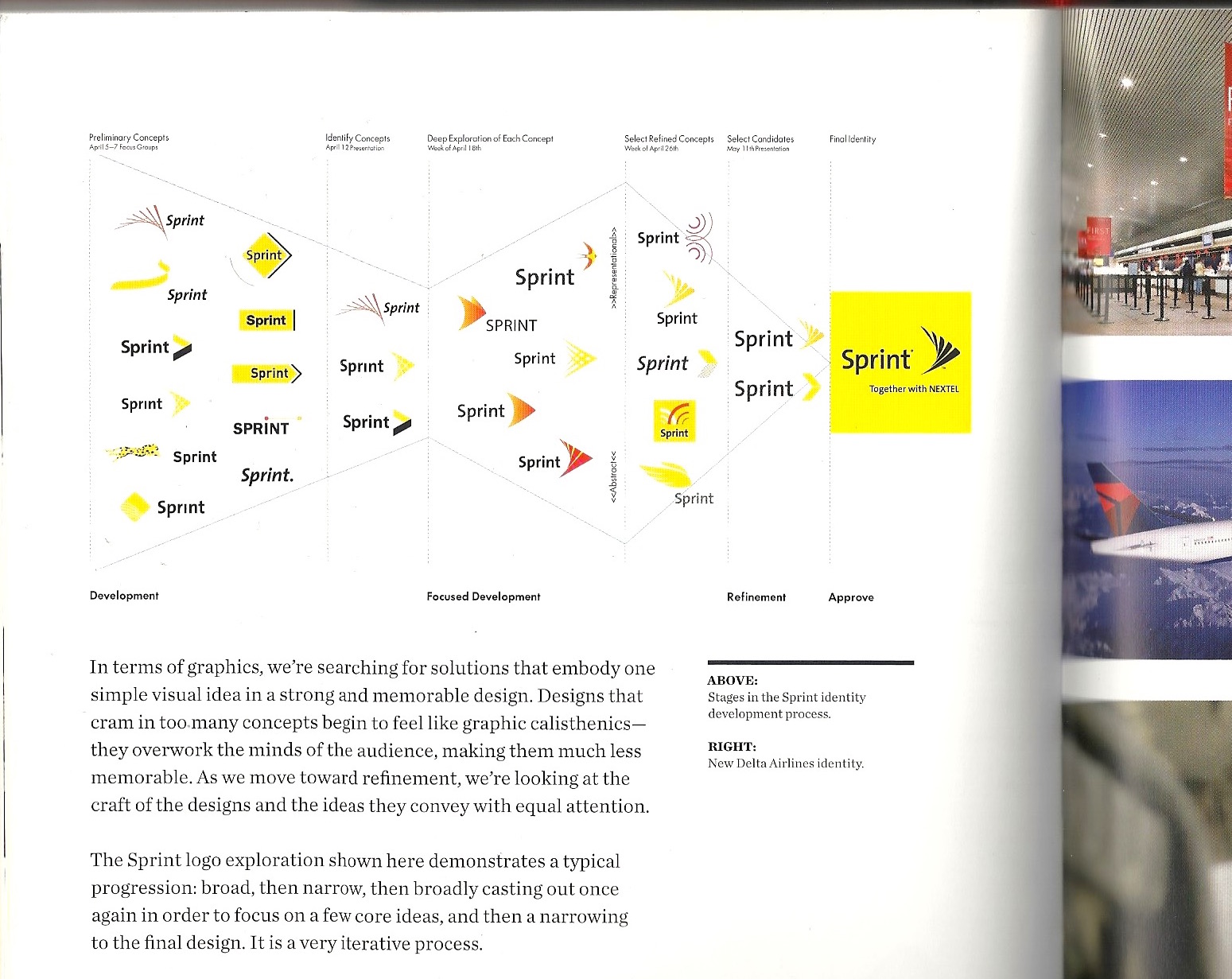
We also see this idea propagated in design books, such as Essential Principles of Graphic Design by Debbie Millman.


The central idea here is that design is shown to be a linear process, with an added dimension which suggests that concepts should be 'expanded' into multiple versions of specific starting points. It is this expansion which is the primary creative vehicle, attempting to force random inspiration into the process. Graphically, this linear process could be shown on a graph as such:


The two main projects I did this year in my fourth year have been an opportunity to revisit the idea of design process, and I have done these two projects in quite different ways. The first, the shop project, which yielded an expensive metal fidget spinner, the Puck, as it's result, was what I will call a 'pick and finish' project:


I chose a pre-conceived concept straight away, and just began it's delivery. This was important for this project in particular, as the required deliverables were 11 fully finished products, so the focus for me was on ironing out the manufacturing process details and difficulties.

My second main project, which focused on 'water delivery in the home' went something like this:


The original intent was for it to be a 'Rapid Throwaway Prototype' design process, where the full length of the project was explored as an intense process in the first week, before going back over to re-consider the decisions were made. It actually became more of an 'iterative' approach, where I went though several exploration stages and several development stages. This was beneficial in two ways:

The deliverables were less material than in the 'puck' project, so I could afford to explore ideas in a more conceptual way, and by continually realising them in 'full resolution' it was easy to get feedback from potential users.

In getting deep into technical depth very early on in the project, I was conscious of minute difficulties such as plumbing thread sizes, household water systems and sink hole dimensions throughout the project, which fed into the design as a whole and meant that I could deliver whatever it was in a short time without hitting too may technical hurdles. Additionally, n having no respect for my current 'idea' I was also willing to throw it away as soon as another idea came along, constantly adopting whatever the evidence pointed to as the current 'best', no work was wasted however, because the insights were carried over.

Why the double diamond is a myth

Can ideas be 'generated'?

Linear design processes feature an initial research stage, followed by a using of any insights gathered in order to inform concepts. The primary feature of this is in 'expansion'. Many a design consultancy website will show a large creative looking spread of post-its and brainstorms, as the team comes together to turn their carefully picked out insights into brand new ideas. The sky is the limit. IDEO are masters at this.


There are some issues however.

Why spend one or two weeks coming up with an exhaustive number of ideas, to then throw them away? The contraction phase of the project, In my experience, often leads to one just choosing the idea they always liked.

Why spend one or two weeks coming up with an exhaustive number of ideas, when you could be spending all the time coming up with ideas? Granted, this is what one does anyway, but the 'model' process should at least take this into account.

Most good ideas already exist. And by that I do not mean that they are on the market and selling in the millions, but most of the last 10 years of innovation milestones have not come from a quick thursday afternoon post-it session, but are things like the iPhone, iPad, electric car and social media, which in some latent, sci-fi sense always existed, they were just waiting for people, technology and the economy to 'deliver' them.

I think the reality of idea generation is that we are really looking for random inspiration, and finding some systematic way of assuring that. So one good idea is to do some deep initial research on a given subject, and hope something pops out to you that hadn't occurred to anyone else before. But this approach is not per se any better way of finding random inspiration than doing, say 15 mini-projects, going on a three month travelling trip, or going to a zen retreat.


Uncertainties Rule

One problem that designers and, later, engineers find is that on a given project, each jump forward also yields a massive leap back, as assumptions made in the prior stage are shattered by new findings. The 'grim technical realities' take hold. 

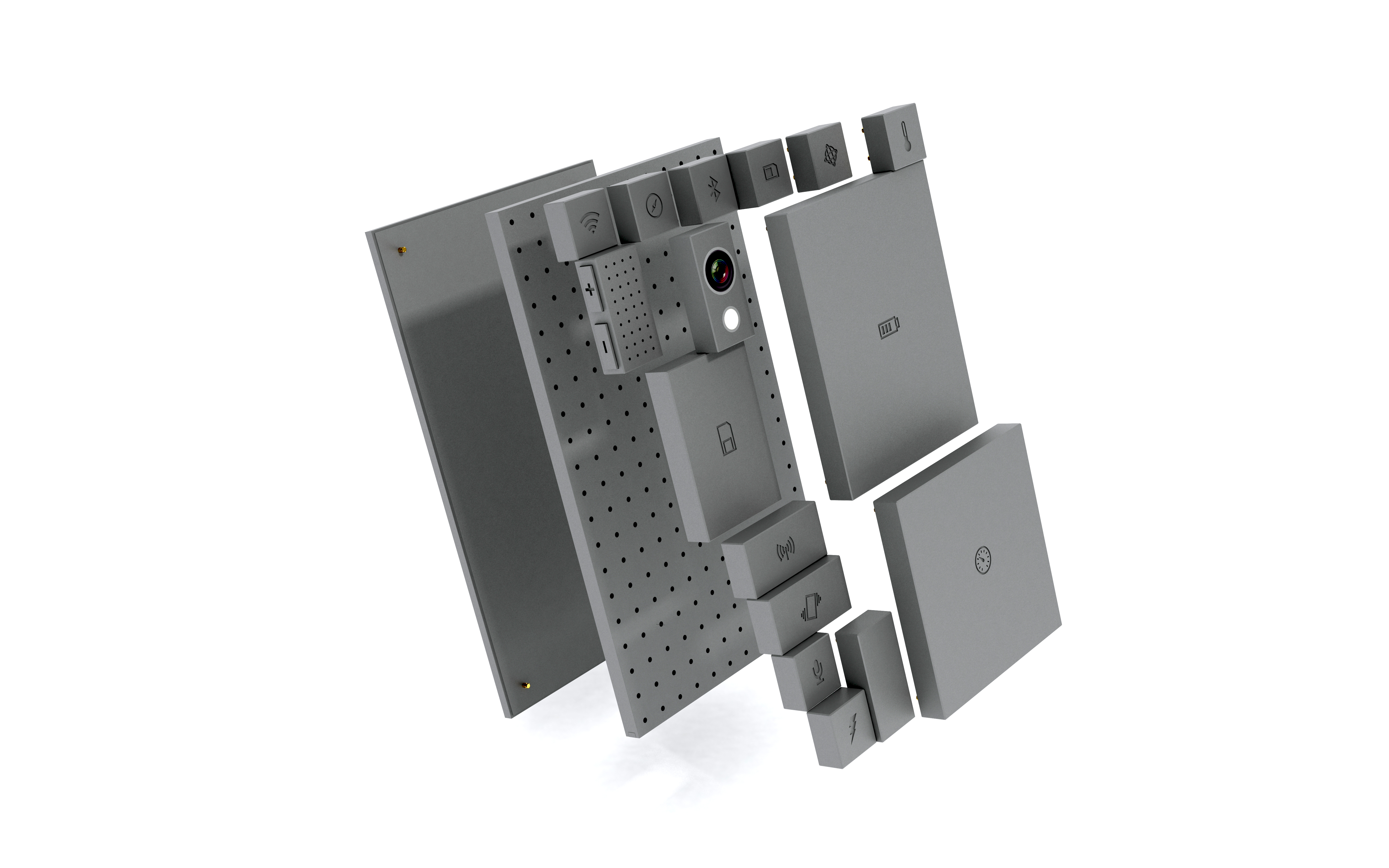
Some ideas, such as Phoneblocks, which became google project Ara, went viral too fast. While an impressive example of a minimal design becoming an expression of a pure conceptual whole, it was merely a icon for the idea of a modular phone and nothing more.


The grim technical reality is that for a number of reasons (motherboard bottlenecking being the most prominent) it is not as simple as it looks in implementation, so Phoneblocks sits happy as a well-rendered and iconic suggestion of a future unlikely to ever happen. The design becomes yet another peice of design media, destined to be just that.

Other ideas are simply watered down for delivery. We see this often in car design, where we are offered a 'peek into' the design process to see a fantastical concept car, which are often only interesting in the degree that they are infeasible.


Usually what happens next is all the interesting stuff gets taken off by the engineers in the delivery stage and we are given the same old car in a new shell, although this is being challenged by the likes of tesla (who don't seem to subscribe to the double diamond methodology).

What is interesting is that the uncertainties don't stop when a product is released. Some ideas like the apple TV and, I may argue, the apple watch, have not properly taken off yet. So they are toyed with and re-evaluated, re-branded maybe in the hopes that they will be revived. Only 56% of new products are successful. (PDMA US Survey 1990,1995,2000) The 4D's doesn't really take this into account, our main problem with it is that in showing the process as specifically two diamonds, it ignores the fact that design is a constantly ongoing and thankless task, instead it prefers to settle at 'deliver' by week 10.

One industry that works in an interesting way in this regard is software, especially the video games industry. Here 'beta testing' and 'early access' are becoming the norm at the expense of fixed, single price releases. Minecraft, one of the most successful video games of the last 10 years was released as a small project and has been continually updated and refined since. How can this influence the way we think about product design?


Design as an intuitive process


Design in it's more 'serious' forms - Corporate R&D, Design Engineering and Consultancy - clearly require certain measurable amounts of accountable progress. Especially those that are beholden to their investors and marketing departments. But a lot of what has really changed things in the last 20 has come from 'headless chickens'- the aforementioned example of Minecraft and 'Notch', the apple computer with Wozniak and Jobs, the world wide web with Tim Berners Lee and Facebook with Mark Zuckerberg.

These were tinkering passion projects that became something bigger than intended, through a useful mixture of dogged determination and of being-in-the-right-place-at-the-right-time. Many of their pioneers found themselves in a favourable position and, with little professional experience, took the right opportunities.

So when we think of who is going to deliver the Next Big Thing, and how it will be delivered, we can almost be sure that it won't be from a giant like IBM, Ford or 3M, but probably from someone tiring away in a garage or in a university dormitory on something pointless. If your design process is organised and accountable, you're doing something wrong.


So why does the myth persist?

Rapid design with throwaway ideas, and the iterative process have recently been beneficial for me. I worked though at least 4 final concepts, before throwing them away and developing something different. At the end though, in my final submission to a rather important client, all that work had to be masked over/ thrown away. An idea is best presented as a Bish-Bash-Bosh of Problem-Insight-Solution, or simply cleanly presented with as little etherial justification as possible. No need to risk sounding unsure about oneself. 

Ideas for commercial release need to be very clear and specific in their intention in order to generate investment and to enthuse the public. This clarity may be arrived upon by failing (internally) several times before coming up with something suitable for release, but it must be cleaned up before it is shown to the public. Apple are masters at this.

In Objectified, Jony Ive talks to the viewer about the design process at apple, and how it manifests itself in a design language. I have taken a rather extensive quote:

"So much of the work with the macbook was experimenting with different processes... so many of the products around you want to make you very aware of how clever the solution was...[what we focus on at apple is]...not the terrible struggles that us as designers and engineers had in trying to solve some of the problems"

I think from a marketing perspective, letting consumers too close to what in reality may be an erratic design process, is not just annoying and not interesting, but risks communicating uncertainty. You're better showing off one half-good idea confidently than giving the consumer a choice. This is especially the case in hardware design, where a fixed lump of material is exchanged for a fixed lump of cash in one transaction.

What this means is that even internally in the industry, from tarted-up student design journals, to professional portfolios, to multinational trade fairs, the exciting and productive world of making mistakes and having-no-idea-what-you're-doing is hidden under the carpet. This costs the design world an opportunity to celebrate the world of the mad and creative, but also of the visionary and  pragmatic ideas that need to be brute-forced over several years out of solid steel or C#.


***

So is the linear design process, and specifically the double diamond, a myth? Yes and no. Projects do overall need to follow some progression in terms of meeting final aims, so measuring and aiming towards this is a good way of trying to plan. It is also a useful educational tool, and it probably gives structure to corporate projects where  they are otherwise lacking in motivation. That’s probably true, but isn’t a very exciting conclusion. I think in reality design is both less and more complicated than we give it credit for.

There are really, in my opinion (or at least this week's opinion), two centrtal and complimentary components of the 'design process' over any length of time or amount of definition these are:

Realising Inspiration


and

Trial and Error


Realising Inspiration is about finding inspiration (which will more than likely be random), and increasing it's specification and resolution. this is equivalent to the Define and Deliver stages of the double diamond, although I am not suggesting here that there are only two, there could be 50 realisation stages in designing a piece of jewellery, there may be only one in designing a £1.3bn bridge.

Trial and Error is the acceptance of failure as a central component of the design process, in this case, we take out 'realisations' and force them to breaking point. We can do 50 at a time to find the best one, or we can do one at a time and constantly improve upon it. This can be seen in software engineering, as updates are constantly streamed to our devices, but also in more solid objects, such as the commendable Porsche 911 which has seen gentle updates throughout it's astoundingly long life. Dyson actually do have a marketed and presented design process that resembles this, especially the focus on trial and error. The submission page for the James Dyson award specifically asks for it.

My intention here is not necessarily to destroy the double diamond, but to remove it's main flaws - the fact that it relies on 'expansion' over any other kind of random inspiration, and the fact that it is conveniently packaged into whatever length of project that budgets or college timetables require. In reality the specific type of process needed is dependent on what is required from the project. In some cases even, it is interesting to pick a process first, and see what comes out of the other end. It is always enjoyable though. Bring on the next one!


31 January 2018

Ornament and Crime? - GD07

Note: As written, Certain elements of this post take loos' racism too lightly, my views have shifted since this publication and therefore i have made a few edits, especially in the introduction. There are certainly racist veins in architecture and design, a lot of that connected to modernism as a whole and it's rejection of 'uncivillised' perspectives. The following article is a starting point to see alternative perspectives, but more can be done to acknowledge how certain modernist polemics have ignored different races, ingored humanity, and worked with established power structures to the detriment of minority communities. https://www.architecturalrecord.com/articles/14738-three-architects-discuss-whiteness-and-racism-in-the-built-environment


I recently went back and acquainted myself with Adolf Loos' Ornament and Crime, specifically a collection of his essays compiled by Ariadane Press and translated by Michael Mitchell.

Having subsequently read much drier but more complex books, such as Art as Experience, I have rediscovered that the book is a rollercoaster, if polemical. It is full of exaggerated stereotypes and angry reflection on the world, giving an interesting picture of 1900's Vienna in the meantime. A lot of the book is naiive, outdated, and contains undeniably racist thoughts. It is important to acknowledge this when coming into this book, especailly because of the strong influence it has had on architecture.

Focusing on the architectural implications of this work, his central argument, specifically in the main Ornament essay, has two components, one, the most famous, is that:

"cultural evolution is equivalent to the removal of Ornament from articles in daily use"
Ornament and Crime, 1908 (1932)

Backed up by analogies to the 'papuan' who tattoos his face, by comparison, in Loos' generation,

"Don't you see that the greatness of our age lies in its inability to produce a new form of decoration? We have conquered ornament, we have won through to lack of ornamentation."
Ornament and Crime

The context for his arguments is twofold, they are both as a reaction against the aristocratic eclectic revival style, which reached a peak before the turn of the century;

"the School of Applied Art sets the tone... over the last twenty years the doorknobs have given us first renaissance, then baroque, then rococo calluses on our hands"
The New Style, 1878

He also argues against the 'new style', that being art nouveau, or in the form it found itself in vienna, as the secession:

"Bing's L'art nouveau in the rue de Provence in Paris, last year's exhibition in Dresden, and this year's in Munich will have to agree: the old styles are dead, long live the new style!"
A Review of Applied Arts I (1898)

He continues, turning away from sarcasm,

"And yet we cannot rejoice in it. It is not our style. It has not been born of our time. There are objects that clearly bear the stamp of our age, objects we like: our clothes, our gold- and silverware, our jewels, our leather goods, things made of tortoise shell and mother of pearl, our carriages and railway cars, our bicycles and locomotives. It is just that we do not make much fuss over them.

These things are modern, that is, in the style of 1898"
A Review of Applied Arts

In product design terms:

"Take the thonet chair. Is it not the fruit of the same spirit as the Greek chair with its curved legs and its backrest, without ornamentation, the embodiment of a whole age's attitude toward sitting? Take the bicycle ...  If the Greeks had made a bicycle, would it not have resembled ours, right down to the very last rivet?"
A Review of Applied Arts

His problem with art nouveau then, and the secession, and the Werkbund that followed, was that they were intending to pursue a 'new style' that was no longer needed. The advance of culture and of the machine age was to eradicate the very need for style.

In his mind, it comes from an attempt by applied artists to barge in on the new manufacturing culture:

"do we need applied artists? my answer is no ... Our carriages, our optical instruments, our umbrellas, our silver cigarette cases and ornaments, our jewelery, and our clothes are modern. They are modern because so far no artist has tried to barge in and take them under his - unqualified - tutelage ... Those barbaric times, where works of art were combined with practical utensils, are over once and for all."
Surplus to requirements (The German Werkbund) 1908

 His main arguments come to the conclusion that most of our objects, our beloved posessions, in the turn-of-the-century middle class at least, were of an indeterminate, accidental, unadorned, but most of all a progressive style: that of no conscious style at all.

So we have got over the secession style, and in fact, the free market did that for us, replacing it with Art Deco, or the International Style, or Streamline Moderne, or whatever else; so what use is all this to us now? Loos' argument comes from the rejection of style all together;

"What is style anyway? It is hard to define ... If you have a lion's head on the nightstand, and the same lion's head on the sofa, on the wardrobe, on the beds, on the chairs , on the washstand, in a word, on every object in the room, then that is style.. Woe betide those unfortunates who dared buy some additional item! Their furniture refused to accept anything else near them."
The Interiors in the Rotunda (1898)

especially that of 'top down' style:

"I am against the trend [Otto] Wagner represents, which sees a positive advantage in having everything in a building, right down to the coal shovel, come from the hand of one architect"

"Who should do it then? The answer is quite simple: Every man his own interior designer"
The Interiors in the Rotunda 

This is an example of how Loos' writing can cut through time and space and give us such relevant insights for our attitudes of today: the above article sees forward directly to the present: to IKEA specifically, and even if it isn't directly inspired, through Corbusier, the CIAM, and Modernism, it has found it's way into becoming a cornerstone of today's attitudes.

But what are the problems of today? Sure, we do not sit at the feet of an all encompassing, applied-artist-led 'style-of-the-day' but as the economy, through the last 100 years, has developed into a giant, consumerist whole, our personal choices have come under scrutiny.

I must note, I do not blame our generation, as a whole, the millennial culture, generally, directly and personally takes action upon global issues. These issues, such as mass-consumption, waste and global warming have been drilled into us and are a central part of our spirit-of-the times, but as designers, we are not sure how to address them. Minimalism, eco-design, and up-cycling are all relevant pursuits. Loos provides an appartent solution for us, in his very famous essay, Ornament and Crime:

"The form of an object should last, that is, we should find it tolerable, as long as the object itself lasts"
Ornament and Crime

He continues:

"A suit will change its style more often than a valuable fur. A women's ball outfit, intended for one night alone, will change it's style more quickly than a desk. Woe betide us, however if we have to change a desk as quickly as a ball outfit because we can no longer stand the old style. Then we will have wasted the money we paid for the desk"
Ornament and Crime

I can illustrate this as such:


So a desk should last longer than a gown, but how do we really 'say' how long things should last? Well ideally, given the climate, forever. We are trying to avoid oppressive, top down braggadocio though, so if we are to be calm suggesters and not polemical, egotistical designers, we should be accommodating to ideas of style and culture. In order to be environmentally courteous though, an idea not really explored by Loos, but more relevant than ever, it appears we are putting things on a scale according to their cultural and material weight.


So we can afford to give the odd evening dress a miss, in terms of our modernist, plain black ambition. But as we climb up the scale, in terms of both the 1900's argument for economy, and our new ideas of conservation, we, stylistically, should be more careful. This gives two important insights.

Given the completely new paradigm of digital technology, music, visual art, and the majority of media comes in a form that barely lasts a day, never mind months. Thus, it can afford to be 'less timeless', which is a phenomenon we see, as the online revolution in entertainment has become more immediate, more in quantity, and arguably less in long-term quality. This is not a bad thing, an instagram post scrolled past in a second might cost the world one milli Amp Hour, wheras before we got a whole newspaper furnished with but four illustrations.

It may ask serious questions about how we define 'timeless' in our generation though. Loos' architecture sought a semi-modernist, semi-classical reduction of ornament in architecture, which went into conflict with the secession architecture of the time, but was arguably already an existing concept in personal objects.

We can see now that, besides a few colours and patterns, objects have pretty much arrived at the non-ornament destination that Loos prescribed and celebrated. None of our phones, from Chinese basics to top-of the range iPhones show any obvious decorative appendage, besides the odd 'interesting' curve. Add to this list our TV's, our computers, our radiators, ovens, printers, toasters and microwaves - essentially everything invented since Loos' time.

Architecture poses a different question. How eager were the modernists in adopting the machine style for their new Villas? But architecture carries an established form. While a bicycle and a train carriage benefit from their birth at a time of new industrial awakening, a piece of building needs to grow as part of the city as a whole. Imagining that timelessness is the most pertinent issue;


Are we better pre-empting the next wave of architectural reductionism, by introducing risky, unadorned forms? Perhaps not. Is an idea that attempts to predict the next two hundred years of architectural progression, to jump to conclusions, the most likely to be timeless?


A conservative answer would be no. Thanks to the Lindy effect, ideas (and that includes architectural theories) last longer the longer they have been about. We are in a place to suggest that architecture, and by extension, more serious pieces of product design, would actually gain in timelessness if they took as much from the past as they did the future. If we invent a totally new thing, we can't look into the past to decide how it should look, but for something so essential, permanent and culturally ingrained as a house, or even more so a library or parliament building, it would be ludicrous to suggest that a tried-and-tested neo-classical form would end up looking more 'dated' than an avant-garde piece.

A vision of the future we could derive from this would be that of neo-classical sandstone brick buildings, furnished with mid-century furniture, and littered with flat, black, technology panels. Sounds like a dystopia? Someone should do a Black Mirror episode on it.

But hang on, isn't that exactly what exists?


05 January 2018

What actually exists - Housing - GD06

As illustrated in previous blog posts, the history of design is highly interesting and nuanced, but in it's most academic heights, it lacks a connection to the common experience of most people. I think this is especially clear in architecture, as 'iconic' historical buildings are rarely repeated and mass produced, despite the intentions of the Modern movement. This is the opposite to product design, where mass production is almost always the inevitable result of the process, and products can be valued in their success by their market acceptance.

A low-key assessment of architecture is required then, to picture and criticise that design which rarely crosses the radar of the aloof design critics. Where better to construct this study than in housing, which is the most actively used and required piece of design that anyone uses. I find myself in my home city of Preston over the winter break, which is lucky, as despite perhaps it's famous bus station, it is a typical provincial post-industrial city of the industrialised west, which has remained relatively untouched by the curse of 'Big-A' Architecture.

A short afternoon bike ride was in order to assess the situation as it exists, from which most of the following pictures were taken.

Pre 1900's building

Before the 1900's preston was a relatively untouched city. In the 1800's it became a hotbed of the Industrial Revolution, specifically the cotton spinning industry which gave birth to a sleuth of practical, cheap building activity.

Awkright House, 1728

It was in this building, of Georgian origin, where it perhaps all began, with Thomas Awkright worked to develop the Spinning. The building itself seems practical and unassuming, a simple classic-esque portal the only sign of architectural intention on the entire building.

5 Winkley Square, 1805

Similar buildings of the early 1800's litter the city centre, made from local red brick (such as accrington brick) with simple fenestration and tellingly classical symmetrical arrangement.

The Guild Pub, 1818

In what was once the gardens of the city, but now very close to the centre, were built houses for the  Nouveau riche, this one, now a city centre pub, shows telling 19th century ambitions, reflecting the complex layouts of real country homes, and with an almost-gothic intention from the sharply detailed gables.

Stephenson Terrace, 1847

As housing became more city-like, there became a few sensible semi-neo-classical townhouse developments, although not to the extent showed by bigger cities such as Glasgow and the like.

Fishergate Hill, 1830/40's


Lauderdale Street, pre-1900's

The biggest change to the townscape came in the mass-developent of terraced housing to house workers at the various mills and dockyards that popped up to support the growing force of the industrial revolution.

Havelock Street, c1870s?

This almost always came in the form of the same traditional building with accrington brick and with simple stone portals and lintels sometimes offering a little more architectural ceremony to what would otherwise be a highly practical building.


Emmanuel Street, c1880s

Plungington, c.1880s


Hartington road, mostly pre-1900's


Post 1900s building

Once we reach the 1900's, we reach a time where, since Mackintosh and Loos have already made their statements, the academic canon regards modernism, or at least proto-modernism having started. However, as we see, in the real world, it has made nary a difference. The roads leading into what were once farmlands have begun to sprout what were out of town houses, and they are built in such a way that reflects the practicality of the Victorian style with a little of the excitement of the fake country manor buildings seen before.

Blackpool Road, Pre-1940's

It is interesting to see how in 100 years, what I assume were very mass-produced houses have each developed individual 'identities' due to diverging styles of update and redevelopment over the years. This happened naturally and is in direct contradiction to both the consistency enforced by International Style and it's fake introduction in the made up townscapes of New-Urbanism.


Queens Road, pre-1940's

Longridge road, my own painting

Post-war social housing 

'Tin Houses', Franklands Street, Preston c.1950?

I assume that the period following the second world war was by all measures a desperate attempt to build and re-build as much as possible to house displaced populations. This required a maximum of short-term functionality and efficiency, which many pre-designed and pre-fabricated housing models rapidly distributed throughout the country. Preston still interestingly still has a collection of post-war 'tin houses'.


It is clear however, despite technocracy, efficiency and practicality were all desperately in need, it was not the time for the International Style (now 20 years into maturity) to step forward and deliver the goods.


Pitched roofs and traditional shapes were still in order, and it's interesting to see how these have been again variously re-decorated over the years, with some even opting to, obviously, cover up the 'honest-to-materials' metal sheathing with more traditional brick-like finishes. How backwards...


Once the rush was off, more 'sensible' developments were authored, affordable housing coming into contact not with the terraces of before, but in away more akin to the 'garden cities' model, with tightly packed buildings surrounding what was to become known as 'indefensible spaces', public lawns and squares.

Savick estate, c.1960?

Notably, these are less modernist than the terraces of before in some ways, as they allude to the village in their staggered positioning, in an attempt to convey individual building ownership where non exists.

Larches, Preston, c.1960?


This nervous self-conciousness of low-income housing was also shown in other ways, each of these housing units contains 4 dwellings, but as much as possible has been done with a classical symmetrical form to 'tie together' the building in a way that resembles a large traditional home.


60's Suburbanisation

Conway Drive, c.1961

The 60's in preston saw a streak of building in the more rural areas of Fulwood. Relatively low cost (to build at least) housing was built at a desirable size in a desirable location, spreading the city boundaries as part of a general Central Lancashire suburbanisation plan.


If one looks in detail, these houses are perhaps the closest that normal housing has been to the International Style: The 'open ended' walls represent more than ever a concept of 'intersecting planes' in 3D, as opposed to a heavy corner mass in the traditional styles. Flat roofs prevail where they can (although it would be ludicrous to avoid gables on the real roof), there is a clear general rejection of applied detail, and the window openings are bigger than ever. 

Interestingly, these large windows are enabled by steel beams in the non-apparent lintels, which have now, 45 years later began to fail, so many of these have had to be re-worked. In their place, the brickwork has been replaced to more traditionally express the lintel.


Again these have been sporadically rennovated to produce a mixed, individualistic street scene. Notice how many of the ambitious flat roofs have been replaced by more long-lasting and traditional pitched roofs.

The Turnpike, 1961


Janice Drive, c.1960

The 60's began a process of, in addition to sub-urbanism and new housing, a system of 'regeneration' where many of the inner city terraces gave way to more modern flats, spaced out and placed in gardens, such as the following.

Hawkins Street, late 60's

This ambition really can't be seen as much of a success, aesthetically or socially, although it is closer to modernism that we have really seen before.

Brook Street, late 60's

Post complexity and contradiction

The world was perhaps shocked following the release of Complexity and Contradiction in 1967, so now we must observe the growth of a post modern trend in housing, and a gradual loss of forward-thinking ambition.

Lime Chase, Late 1970's


The 70's houses of Lime Chase, although it is visually apparent they share the same construction methods of those of the 60's, have reverted away from the rejection of mass and ornament seen then. What we have now is a return to the full-brick style, with some fancy stone-look applied ornament. As we have seen, this rustic stone has nothing to do with the Preston vernacular, but anything is surely better than material honesty.

Redcar Avenue, Ingol, late 1970s, early 1980s

Social housing was less on the pulse, but Redcar Avenue again makes an effort to represent individual homes where none exist.


Daisyfields, early 1980's

These rather more expensive houses, early 80's I assume, represent the same cluttered layouts that the fake-country homes of the 1800's enjoyed, and again a return to the more traditional all-brick style.

Abbott's Croft, mid 1980's

By about 1985, we have reached a zenith of almost-laughable postmodernism in housing, with hollow plastic columns of various orders.


These do though, more deeply than just fake columns, return fully to neo-classical ambitions. Contrast the mass, symmetry and bay-order of these houses to those asymmetrical buildings of the 60's.


Preston's most complete expression of pure postmodernism in housing is the architect-sponsored Riversway docklands development of the early Nineties. By this time nearly all traces of heavy industry in many northern industrial towns had disappeared, but the landscapes they left behind were an opportunity for re-development.

Victoria Mansions, 1990-95


The complex and variegated forms of these housing developments, particularty reflect the work of Ricardo Bofill in Paris, developing, instead of accurate or half-assed classicalism, a complex order of vaguely traditional elements into something new.


Phase IV Student Residences, Harrington Street, early 1990s

Around this time, more 'sensible' developments can be seen in the university housing, although we are clearly a long distance from any kind of esprit nouveau.

Cottam, early 90's
Suburbanisation came further out to the once-village of Cottam. Instead of the ordered, interconnected streets of the 60's, we now have the rather modern idea of distributor roads and endless cul-de-sacs, which are home to even more variegated housing layouts than we have ever seen before.

Coleridge Close, Cottam, 1990's

While an attempt is clearly being made to reject functionalism and 'monotony' the results are at best generic and ironically unrelated to local vernacular, and at worst have a rather despicable 'candy-land' kind of theme going on. This is explored with reference to the american market in the 'McMansion Hell' blog.

Hoyles Lane, late 1990's

Armaside Road, Cottam, early 2000's

2000's-2010's student accomodation

Moor Lane Student Accommodation, c.2004-c.2010

An interesting aside from all this suburban housing is this collection of 'different' student accommodation schemes. All are built on Moor Lane, a lane that once housed some non-demolished postwar housing blocks.


While not quite as bulky, these flats are no less offensive, and each has been developed in a different, 'exciting' market-led style, creating clutter and lack of cohesion in the streetscape.


The further discussion is this: what do we even call this style? It seems the above would have been included in The International Style had it been around in the 1920's, as it combines rectilinear and monochrome details. 


The cluttered, broken exterior and random colors of these buildings is perhaps a relic of deconstrutivist thought, but it serves a more obvious cause - to break up the surface modenature in order to distract the viewer from what is beneath the skin. What is beneath the skin is likely 5 storeys of a boring standard steel frame which has seen little change since it's implementation in buildings very much like the one it replaced.

Now

Since the crash of 2008, building, especially in these outward provinces, had seen a noticeable slump, but as the NIMBYS have been back out in force over the last couple of years, we must be developing again. 

The Tramshed, compl. 2017

Student housing has changed a little from when we last saw it. Perhaps reflecting millenial tastes for industrial honesty, the 'Tramshed' is given a brutal name, and is in style a mixture of minimalism and traditional red-brick Victorianism.

Wesley Chase, 2018- , Barrat Homes

The provision of suburban middle class housing seems not to have changed much at all, if it has, it is more generic and traditional than ever before.

off Lightfoot Lane, 2017- , Redrow Homes

St Edwards Chase, 2016-17, Charles Church

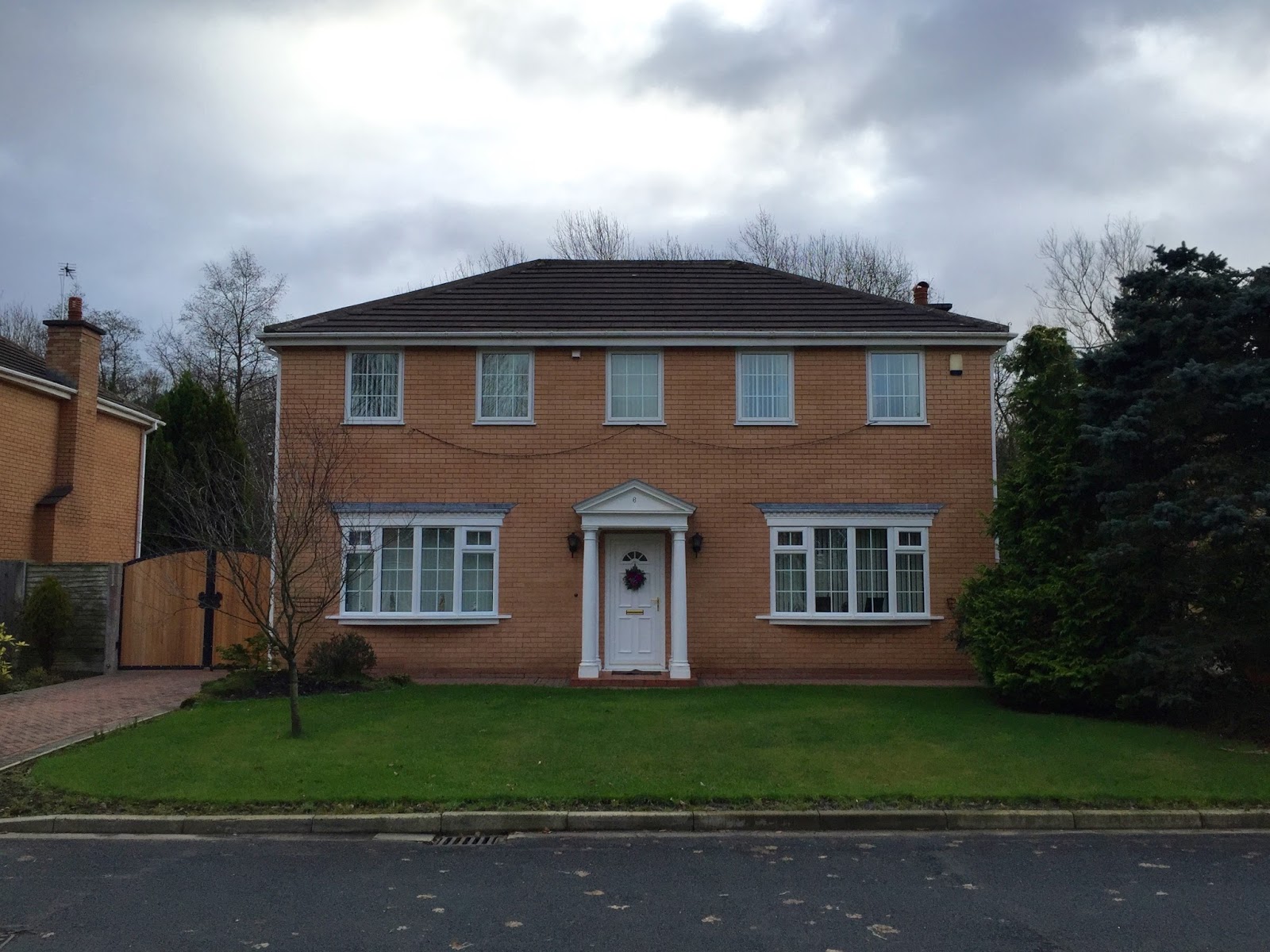
The housing of today by Charles Church, a premium sub-brand of Persimmon homes, are the most interesting, as these have reverted with full commitment to the housing we were seeing in 1805, here we see an old country house almost unnoticeably sewn into a development in the north of Preston.


Silver Hill Gardens, 2017-18 Charles Church


A subtle change in some of these housing schemes is an effort to make them more of mixed-income access. The theory being that if higher and lower income households are they are subtly mixed together, it is better in general for both parties, and avoids 'slummy' districts full of low-earners. The results will be in in 20 years. Will buildings still then be made in red brick in a victorian functionalist style? Probably. They will at least be the least intrusive and most market-acceptable.

All in all then, the International Style, and any subsequent exaggerations or cerebral rejections thereof, have resolutely failed to make any impact on housing whatsoever. I found one international style house on my afternoon bike ride, the surprising Mayfield on Cottam Green:

Mayfield, Cottam Green, c.2000.

This was built around the year 2000, by 'proper' architects David Cox Architects, some 70 years after the establishment of the International Style. if white-box architecture was to make its impact felt in the real world, it would have done by now. However, we still have a nagging feeling that these white, glassy, flat roofed buildings are somehow 'futuristic'. This is propagated the mainstream and architectural media which allow such buildings to still be described as 'future' or 'modern'.


So what we find is that there is barely a connection between the academic descriptions and movements in architecture and design, and how we live, in this case it has been housing, which was actually a new and specific focus of the modernist effort. If there was an impact from the International style, it has now been rejected, both formally and in the mainstream. Recent explosions in architecture such as deconstructivism look extremely unlikely to deliver their futuristic vision to 95% of people, no matter how far forward in time we look. What gives?

Critics like Nikolaus Pevsner have consistently held that "The term architecture applies only to buildings designed with a view to aesthetic appeal". Churches and Museums then, which are still today the major playground of retinal architectural movements like parametricism and blobitechture. A rejection of this idea came with modernism, as much of the 20th century architectural discourse was focused on matters of housing, from Looshaus to Fallingwater to Farnsworth to Unité to Venturi to Abraxas to the Mountain. Despite constant effort from architects to suprise, delight, and convince developers and the public that they have the answers, the 99% remain unconvinced.

This may not be a bad thing however, housing aesthetics, guided by the whims of the free market, remains in a constant state of cautious balance, it represents a 'natural' equilibrium between the style of the times and what has come before, with an emphasis on the before. We can also assume that, as these are free market endeavours, that they strike an actual balance of cost effectiveness, which takes into account the skills of local workers and the availability of common materials and techniques, dare I say it, by some measure they are also the most timeless. This is exactly what modernism wanted to express, but in it's rejection of the past it ignored the obvious answer: that nothing needed to change.