tom lever blog

03 November 2017

Late Modernism - GD04

The first post in this series, Modernism, dealt very accurately with the themes and features of Modernism, the philosophy that defined much of the first half of the 20th century. What happened next?


For whatever reason; boredom, restriction or a new cultural awakening, Modernism was replaced by a multitude of differing styles. In the post on Modernism, I defined it using 4 rules:


1) Rules are rules

2) Form follows function

3) Less is more

4) The future is bright


I see what happened after modernism, that is, after the 1960's roughly, that design went into two camps - late modernism and post-modernism. In support of a 'pluralist' theory of styles, I believe that after modernism, what we have is not a single defining style, but a range of different styles. I see late modernism as a refinement or exaggeration of certain specific aspects of modernism, and post-modernism as a rejection thereof. We can construct a picture of both philosophies by considering exaggeration or rejection of the above four rules.


Late Modernism


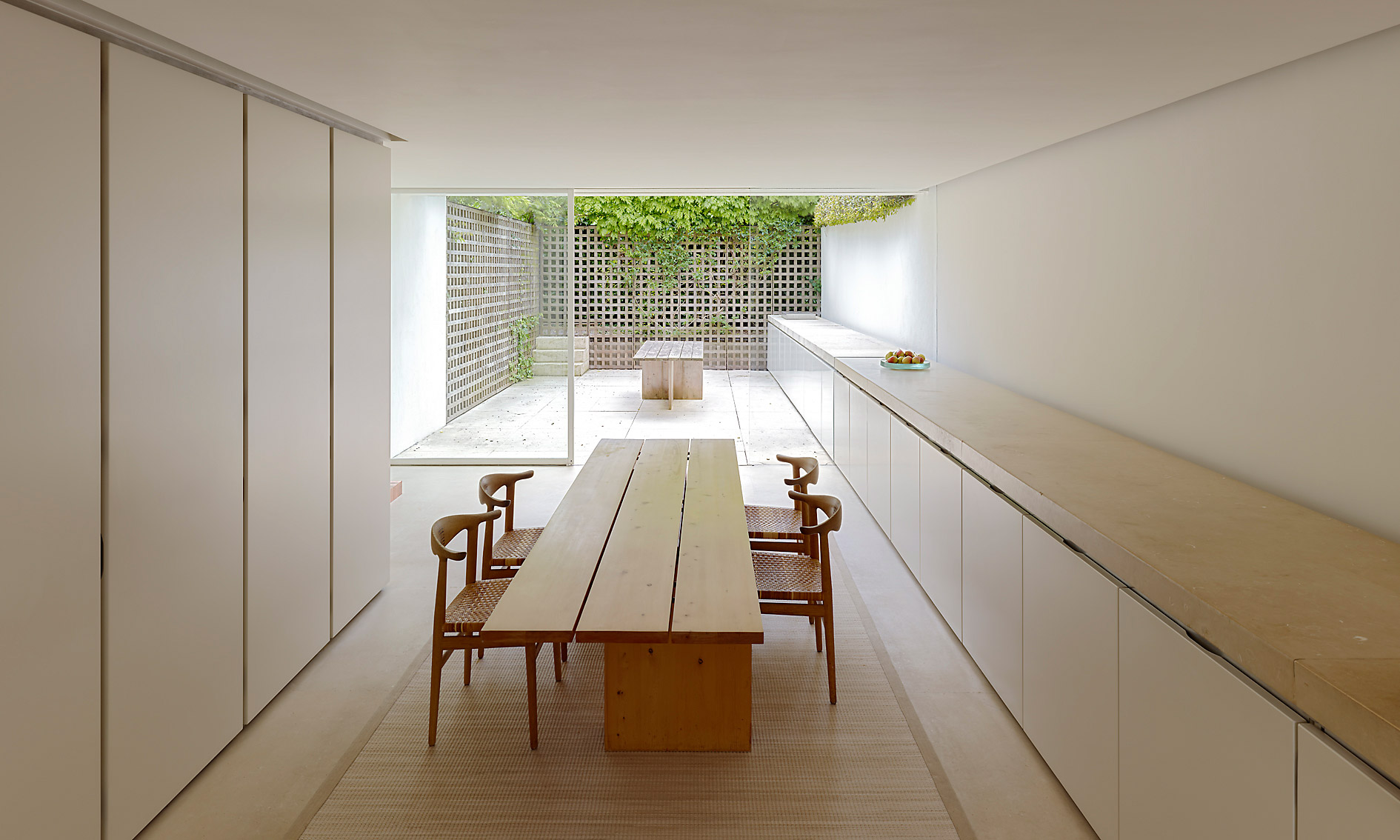
HSBC Headquarters  Norman Foster; Lloyds building, Richard Rodgers; House in Str Tropez, John Pawson; City of arts and sciences, Santaigo Calatrava; Pompidou Centre, Rodgers & Piano; Museo Jumex, David Chipperfield; National Theatre; Barbican Estate; Munich Olympic Stadium, Frei Otto.

What we se here visually is arguably less cohesion and agreement than in the picture of modernism I formed. What we have here is not a single style aiming to continue the utopian dream of modernism. In the real difficulty of merging objectivity, functionality, neutrality & optimism all into one design, late modernists have given up on the wider dream and instead focused on and represented one of these points, usually at the cost of the others.


1) A new objectivity


The modernists believed that rules were rules, often dissolving design theories into simple lists and manifestos. This reflected a belief that truth and human nature were definite things that could be worked out objectively. This manifested itself in square, rigid buildings; useful but technically-minded products and extremely prescriptive urban planning.

Since the seventies, this objective spark has not gone anywhere, but the realisation that structural problems and human nature are more complicated matters than can be solved using only the orthogonal, cartesian plane has elevated the design solutions to a higher, more complex level. Buildings such as the Munich Stadium, designed to some extent by observing the formation of bubbles, still carry the fundamentally modernist belief that the solution is real, definite and specific.


The complex, structural forms epitomised by the architecture of Renzo Piano, Santiago Calatrava, Norman Foster and Nicholas Grimshaw indicate and express complex design parameters, creating a performance of science and technology. This can be impressive, but they can also be rather facetious and tiring examples of self-congradulation. They focus fully on (unnecessary?) objective resolution at the expense of simplicity and clarity.

Kartal Masterplan, Zaha Hadid, Patrik Schumacher

This objective but 'oh so complicated, look how hard we worked' approach finds its culmination in the 'Parametric' designs of Zaha Hadid and Frank Gehry, which, despite pretensions of computer generation, probably owe more to artistic vision enabled by a hard working team of CAD monkeys. This is the latest manifestation of 'objectivity' and despite the claim that they are inspired by the likes of Frei Otto, might actually not be modernist or objective at all.


2) Form follows over-exaggerates function

Pompidou Center, Renzo Piano, Richard Rogers and Gianfranco Franchini, 1977

While arguably intelligent modernist design like Gropius' bauhaus building in Dessau and Wagner's Postal Savings Bank moved forward the world of design by omitting ornament and utilising glass and steel, by the 60's this had become the International Style, one that was boring, formulaic and repetitive, especially when done by minor architects not vested with the poetry of Le Corbusier. The solution was reached with the completion of the Pompidou Center in 1979, which is desperate to make a 'punk' statement, but is still reluctantly beholden to the rules of modernism.

It achieves it's objectives by using the functional systems that it is required to have as the ornament itself, proudly displaying them as a sculpture to the rational mind. There are a more than a few contradictions here. There is no real reason to paint the air ducts blue, and i'm sure insulation and security are also hindered, not to mention longevity of the exposed parts. From my experience with it though, it is actually a functional, flexible and open space.

Richard Sapper's IBM Thinkpad: Why is the screen so off centre? Why are the hinges so different? Dieter Rams wouldn't have allowed this.

It is in product design where this high-tech style often shines, as the focus is fully on the legibility of the product. One can't avoid mentioning Richard Sapper here, who's designs, especially the ThinkPad, communicated and exaggerated both the functional details and the mechanisms required for the portable computer which, rather accidentally and conveniently probably enhanced the usability of the machine, but most importantly gave the humble PC a solid, confident, emotional and highly marketable form.


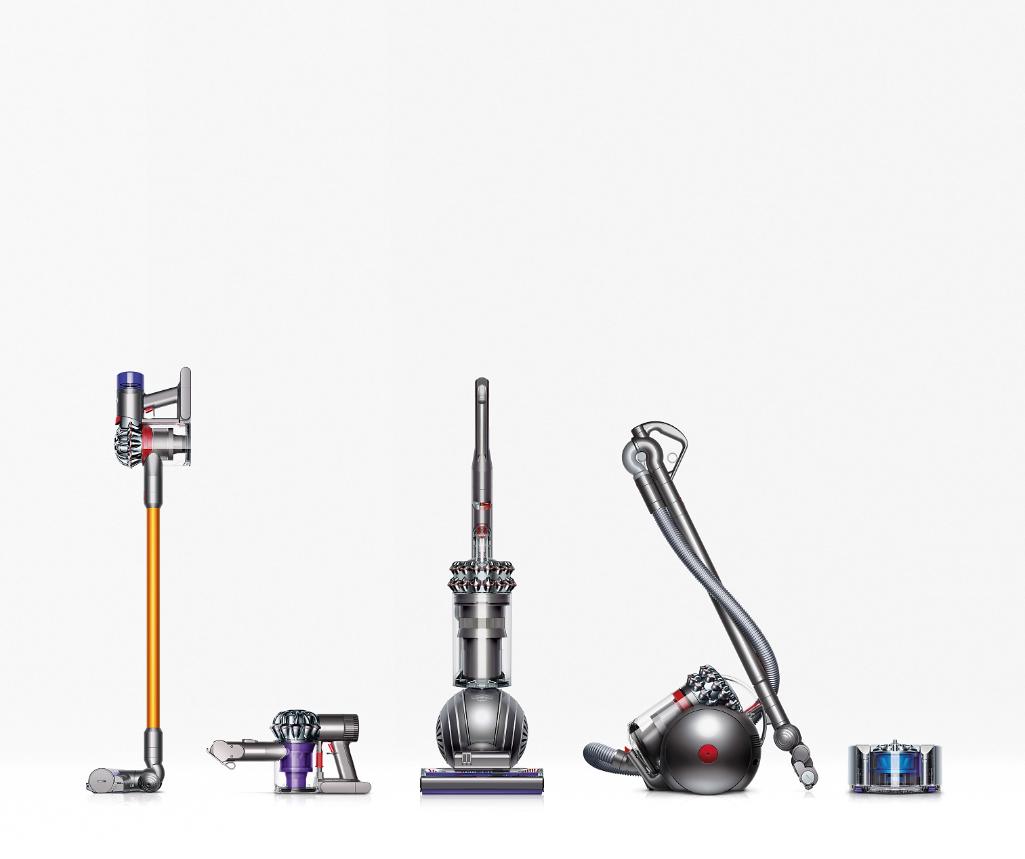
Despite Dyson's claim to the contrary, their products are self-conciously high-tech. They are another example of the over-exubirant celebration of functional matters. This is not a bad thing, high tech design is often a bit babyish and condescending, but the philosophical attitude which puts functionalism at all costs front-and-center is probably the easiest and definitely least compromised way of delivering both utility and 'Big-D Design'. Again though this comes at the cost of attaining the 'Zen' of more sedate versions of modernism.

3) Less and less


While 'Less is More' was an integral part of modernism, from Crystal Palace to Adolf Loos to Mies Van Der Rohe, most pre-seventies modernist architecture of academic regard (Johnson's Glass House and Mies' Farnsworth House excepted) represented a balance between function and reductionism. As the above late-modernist movements of the seventies looked to do more with more, there became something to react against. Tadao Ando's Azuma House (although not as minimalist as we may think) does a lot to represent less as a goal in itself.


Adolf Loos' very clear arguments for less at the turn of the century were focused on reduction of ornament for 'civilisation' but also for reduction in labour. Late modernism's less focuses fully on the aesthetic effect of minimalism - the zen peace of mind associated with lack of distraction, and the communication of luxury through excess space and premium materials.


We also see a turn backwards in minimalism, while the modernists broadly attempted to re-invent forms at any opportunity as part of a forwards thinking desperation, in the effort for 'essentialism', we see in the work of Naoto Fukasawa and Japser Morrison, and in the Architecture of David Chipperfield, a tendency for reduction away from innovative form to more traditional or stereotypical forms. This is part of the goal of minimalism to enhance the anonymity of their design. This does enhance the unobtrusive point that modernism sought to address, but can't be argued to be as forward-thinking as 'proper' modernism.

Sam Hecht of Industrial facility says:

"The less you see the designer's effort in the work, the better - effort should not be a visual commodity, it's simply a means to an end"

But it's also his design that results in extraordinary prices for simple MUJI electronic goods, so if minimalist product design doesn't exemplify the designers effort in an overt visual sense, it does in it's communicating the designer's commitment to the reduction of visual detail, which is even harder.


Minimalism probably does come from an innocent and pure philosophical standpoint, but in today's market economy, it has found it hard to separate itself from the very attractive fashion of less being understood to be more, the very symbols of less becoming a kind of ostentation in themsevelves.


4) The future is bright great?


Brutalism is where this late-modernist argument gets sticky. Does the gritty aesthetic of something like Le Corbusier's Chandigarh parliament building exemplify optimism or does it channel the exact opposite? 


I feel like I can use brutalism as an example of modernist optimism exaggerated , if only in the sense that if it was sensible optimism it wouldn't try so hard. Regardless, the subject-matter of brutalist development in the 60s and 70s was nearly always publicly funded and optimistic.


Even in other types of design, such as Kenneth Grange's designs for National Rail, there remained a collective, ambitious longing for proper 'Design' to be a part of the fabric of life. Helvetica wouldn't be the first option for the independent train services of today.


Late modernist design, especially in Britain, usually found it's embodiment in social brutalist developments. As I have previously argued, the aesthetic may derive from a certain contempt for the conditions of the lower-class built environment, but there remains a thread of the architects effort in doing as well as they can. They tried. Postmodernism had a significantly different way of communicating that effort. Brutalism did more than any other visual movement to deliver the optimistic goals of the post-war housing plan, and in all regions across the world it still stands as a symbol of futurist (if naive) belief in the power of concrete and technology to deliver real social change.


***

So here we have explored the world of late-modernist design. In this article, I have argued that late modernism is a movement that spans from the 70s to today that exaggerated modernist tendencies at the cost of the whole goal. There are criticisms of such an approach:

I have only studied the most obvious aspects of 'Big 'D'' design in my approach. therefore, I have given later movements, which benefit from higher historical resolution, the credit of being more variegated and nuanced than older movements. The early 1900's had it's fair share of senseless visual fashions, from Art Deco to Streamline Moderne to Googie , which are irrelevant to contemporary study in the sense that they don't tell the story we are trying to tell. I Ignored such styles in my 'modernism' post and I continue to ignore 'popular' visual styles in my attempt to explain the very superficial movements that define what is considered important 'Design'. People weren't actually buying Richard Sapper lamps in the 70's, they were too busy being distracted by the likes of the Russel Hobbs 'Futura' kettle.

Having said that, Modernism is definitely still a movement that refuses to die, even in this narrow, superficial and misguided sense. The very idea of ideal form, committed, minimal and logical is something that is universally hard to argue against, despite despair-inducing historical (and current) experiences of places like Chandigarh Sector 16C, which prove more than anything that architecture and design needs to be something at least marginally more than less.

The high culture of the 80's had something different to say. This made it's impact in the form of a radical diversion from the modernist trend, a design theory that sought to reject every core of modernism with gay abandon. But perhaps the real damage had already been done by this point. Complexity and Contradiction or otherwise, what we can see from these examples is an architectural model which has reverted totally to retinal representations of the real problems that modernism honestly sought to actually solve. Less, more or anything else, it is clear that by the 70's the academic design practice was only really in the game of designing lamps, chairs, cathedrals and museums; the hard theory finding it hard to interact with the fabric of the real world.


22 October 2017

What is Design? - GD03

There are two very different definitions of design, 'Design with a capital 'D'' and 'design with a little 'd''.

This year, we are being asked very explicitly to define what it is we think 'great design' is. A good first step is to look upon the dictionary, where we can find a definition of design in a very loose sense.


Dictionary.com:

Design:

Verb (1) to prepare the preliminary sketch or the plans for (a work to be executed), especially to plan the form and structure of.

Noun (1) an outline, sketch, or plan, as of the form and structure of a work of art, an edifice, or a machine to be executed or constructed.

So to design is to plan or sketch, the result is the design. But this is a very limp definition of design; what man-made things are not either art, machine or edifice? The conclusion here is that design is the plan, and the outline of anything, and also the planning and outlining thereof.

What we must also remember however, is that despite design being seen as a process in itself, it more often occurs as an intuitive and direct part of the production. When we make a cake, or dress ourselves, organise our desk, make a cup of tea or write a memo we are planning and structuring the form and the arrangement of the following decisions; we might prefer a cup with 80% tea water brewed for 1:30 with 1.5g of sugar and 20% semi-skimmed milk, and these considerations are 'designed in' at every stage of the process. design is a component of basically everything we do.

Can we design the perfect cup of tea? The modernists probably think we can.

So there we have it, design is one, but such a definition is very unhelpful. In this context, 'great design' is anything that anyone wants, which might be the one truth at the basic level, but it carries little of instructive value. The above is what I will term 'design with a little d' - design as a process and result to meet certain external ends.

The reason I have approached a split in the definition comes from a number of sources. I was quite annoyed by Nikolaus Pevsner when, in An Outline of Eurpoean Architecure, he opened by saying:

"A bicycle shed is a building; Lincoln Cathedral is a piece of architecture. The term architecture applies only to buildings designed with a view to aesthetic appeal"

But in the context of him writing his book, this is an essential statement, he aims to write about proper, fancy buildings and their development over time. This will tell us a very different, higher-class version of philosophical history than a study of vernacular building over the same period.

Peter Schumacher of Zaha Hadid Architects was once angry that design criticism focused too much on political correctness:


In a way, he is right: 

"as if the delivery of social justice is the architects competency" 

being a key quote. One way of looking at design is first asking what is the designers core compitency? A proper Designer wakes up in the morning, makes themselves a coffee in their Bialetti Moka, puts on the all black Yohji Yamamoto gear, drives to work in their Audi TT, arrives at their Richard Rodgers office building, picks the Moleskine up from the Vitsoe 606, sits in the Herman Miller, gets out the LAMY, turns on the Tizio, and gets to work. But what are they there for?

For that, we must look at some more aloof definitions:

Le Corbusier, 


"If my house works well, I am grateful, as I would be to the railroads and the telephone company. But my heart has not been touched. However if the walls, rising up against the sky, affect my feelings, I become aware of your intentions. You were harsh, charming, or dignified. Your stones tell me so"


John Dewey, 'Art as Experience'-

"The word "design" has a double meaning. It signifies purpose and it signifies arrangement, mode of composition ... A work of art is poor in the degree in which they exist in separation ... Only when constituent parts of a whole have the unique end of contributing to the consummation of a conscious experience, do design and shape lose superimposed character and become form"


Bruno Munari, Design as Art

"What is a Designer? ... He is a planner with an aesthetic sense ...  He gives the right weight to each part of the project in hand, and he knows that the ultimate form of the object is psychologically vital when the potential buyer is making up his mind"


Paul Rand, Conversations with students

“Design is relationships. Design is a relationship between form and content.”


What we can garner from these more academic, authoritative statements is that the Designer's job is to control the aesthetic experience of any given solution. And I don't take the word aesthetic very lightly, I don't mean mere styling. Yes, the look of the product is a big part of the end result, but to be a completely controlled experience one must take into account the weight, feel, impact, sound, and most importantly the user experience too*.

A design that focuses on delivering aesthetic experience as one of it's core goals is therefore an example of 'Big D' design. At the start of the year I came to school with the following piece of paper.


Here, Great Design is considered something of philosophical purity. And that is what we see when we consider most of the 'icons' of academic Good Design. It is the result of such a complete process where style, production, feel and use have all been considered with the aesthetic experience as the final goal.

In class, this ruffled a few feathers. The Tizio is flawed, masculine and overly expensive, but is is also aesthetic, which was really it's only job. This is why the split between design and Design was necessary.

'design', that is, design-with-a-little-d, has many factors; these are the factors concerned with production in a wider sense: Financial concerns, Marketing, Legality, Safety. There are, more viscerally, the Ethical concerns of design: mass second-world labour, the environment, the emancipation of the poor and the disabled. Victor Papanek is our greatest source on such Ethical issues:

"Only a small part of our responsibility lies in the area of aesthetics."

"Much recent design has satisfied only evanescent wants and desires, while the genuine needs of man have often been neglected by the designer."

The above are totally true, but we flip-flop back to Peter Schumacher.

"as if the delivery of social justice is the architects [designers] competency" 

In fact, both are true, and I look to belittle neither point of view. Having said that, Peter Schumacher is obviously the candidate for the 'most evil man in design' prize.

With two definitions of design, we can have two definitions of 'great design'.

From the view of 'design' as a tool, design is a process and a capability with which we get from point A to point B. The question here is what do we do with this ability, which is an ethical question. In little-d design, 'great design' is 'great' done via 'design'. This is what Papanek advocates. The problem here is that there is a very, very large field of 'great' possibilities, most of to which Designers are not directly in a position to help; their solutions are Political, Financial and Charitable. 'Great' but not 'Design'. We could spend all day doing directly good things, but then why did we even bother becoming designers in the first place?

From the view of 'Design' as an aesthetic end in itself, we are in a clear, but more ethically ambiguous place. We all enjoy good food, music, art and so on, but what is their real value? In this context, it doesn't matter. The designer, artist, architect and chef are here to make great things, that is what they are for. Is a phone worse because it contains unethically sourced cobalt? Most of us have one and enjoy one regardless. 'Design' is fenced away from these concerns. 'great Design is 'Design' done well' that is all it can ever hope to be.

***


Why didn't I just call one of the 'designs' planning, or aesthetics? Because I am not yet ready to relegate one of them to 'not-design' just yet. Clearly there is a very tightly strung network of concerns around the whole subject, the subject-matter of design is one that can be delighting and horrifying in equal measure.


Notes:

*The common assumption is that user experience design is necessarily the practice of 'good' user interaction. This is not always the case. A well-thought-out and aesthetic negative user interaction is just as valid.


08 October 2017

What is Luxury? - GD02

One of the questions that has been thrown up at the start of my new design project, one focusing on selling items in a rather middle-class shop, is this; What is Luxury? Anything aiming for added-value sales must go beyond meeting functional requirements (or ignore them) and seek to extract value in some other, more mysterious way, one commonly defined as 'luxury'.

Google image search is no help:


What we see here is actually quite a maximum of variety in style, from ultra-functional aeroplanes and sports cars to ultra-modernist building to classical architecture and car styling. What we do see is a range of images that stop at nothing to display wealth. What comes first, style, luxury or wealth? Is it possible to obtain luxury on the cheap?

In a more rounbdabout way, I get close to this question in one of my series of kettle posts (it still isn't over!), my answer being that the price gap between functional product and anything more expensive is by definition design, or at least the result of 'Design' with a capital 'D'.


A key theme of one my often-referred blogs, Misfits Architecture, goes more accurately to the question of wealth and luxury by considering the history of canonical Architecture and Design (classical - gothic - modernist - high tech - postmodern.. ect..) as a history of styles that are necessarily expensive displays of wealth and ownership.

“Aesthetics give shape to our values and aspirations. This is not necessarily a good thing.

An aesthetic loses its usefulness when its connotations of status are lost, and any process of refinement stops.

Buildings require money and land to build. The history of architectural aesthetics is the history of articulating the ownership of wealth and property.”

It considers the canonical history of ‘meta-aesthetics’ - movements such as high-modernism, high-tech, post-modern and minimalism as styles that contain inherent status as they yearn towards results that are neccecarily expensive. We can observe ourselves that nearly every canonical 'Design' style of the last century overt displays of wealth:


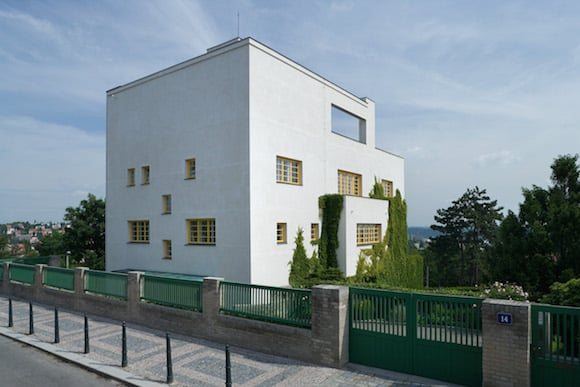
The awe-inspiring Looshaus in vienna, despite being a rejection of traditional form and style, is gladly assisted aesthetically through it's use of ostentatious marble cladding.


Corbu's Villa Savoye, despite it's enthusiastically poetic interior, is assisted externally by the fact that it has a 'stance' which dominates and indicates ownership of a large, flat piece of land, and in it's day would have presented ownership of the river-view as well. These might not be the core reason for it's aesthetic value, but they are certainly what mark it out as an object of luxury. The same can be said for FLW's Fallingwater.


Postmodernism isn't hard to debunk as a style of materialism and ostentation, but it's easy re-emergence into relevance on dezeen these days tells us a lot about how it gains it's weight as a cerebral, intellectual adventure into 'fun' expression. If this was the natural style of human expression then it would be what all the chavs would be doing. No, it relies very heavily on it's middle-class understanding as something of artistic and philosophical merit, and it is this potential for subtle bourgeois inter-communication from which it derives its value.


Minimalism seems to perhaps be the antithesis of showy 'Design', but look deeper, what does it rely on? Fundamentally it relies on lack of panel gaps and honest, plain materials; removal of the real, inconvinient details such as mechanisms and handles. Rumours suggest that an apple store table in all it's solid-wood, seamless glory costs in the region of $10,000 - 20,000. Seamless 'extrusions' of real stone cost orders of magnitude more than Corian, not to mention the half-assed coated chipboard that we have to put up with. Imagine being able to actually keep a house clean too, no John Pawson house could last 5 minutes past it's photographed state without an army of housekeepers, think of the status that demonstates.


High-Tech is another style that has failed to keep to it's socialist roots, the star-status of Rodger's NEO Bankside is enough to make it premium property on it's own, not to mention the well-communicated view over the thames (despite stares from Tate Modern guests) afforded by it's expensive massive plate glass windows and it's probably-useless exterior 'structure'.


Brutalism proved (up until the last few years) as something which legitimately was a canonical 'Design' style which avoided luxury. It communicated honesty to materials, but the subject of that honesty was thick pre-cast concrete, decidedly cheap and ugly (especially in wet climates). It managed to make this into an aesthetic, but due to the medium, the only aesthetic available was one of strength and despair in equal measure. It found it's outlet in social housing schemes in and in monumental public building, the heavy hand of the government giving us what we want? Maybe, but certainly not luxury until millennials realised that any dream of housing at all was a luxury and decided that the only way to retain their self-identity was to re-brand brutalism as aspirational.

A guide that will take us away from the already-done architectural criticism and towards a more Product Design scale is the good example of car interiors. These are all designed for exactly the same human interaction, but do it in completely different ways. All still communicate 'luxury' but their version of what luxury is is "same same but different". We also all have a well established internal hierarchy with regards to the social degree of car brands, as these have been heavily enforced by marketing during the course of our lives.


BMW - Premium Materials, but notably the prentention of ‘attention to detail’ and ‘german engineering’ conveyed by it’s accurate detailing.


BMWi - Luxury because it uses premium materials and new technologies.


Rolls Royce - Luxury because it uses premium materials, is hand-crafted, and would be inconvenient for anyone who had to maintain the cleanliness of the car themselves.


Range Rover - Luxury because it uses premium materials and because it is an fetishistic object of functionally overconstrained overkill.


Ferrari F40- Bare bones, but obvious overkill, and the weight savings are the result of things like carbon fibre and Kevlar, which were ridiculously expensive.


Ford by Marc Newson - Okay, not a production car, but we can clearly see another example of hard-to achieve minimalism identified by lack of panel gaps. More importantly it was ‘Designed by the guy who made the lockheed lounge’, giving it middle-class cultural relevance.

Now this isn't the most mainstream study of luxury design ever, one could focus on Rolex, Mulberry and Burberry, all of which are on an even more basic level defined by 'craftmanship' and 'quality (read: cost) of materials'. The question gets more tentative when we introduce Etihad first class flights, Four Seasons hotels and Vegas Casinos but in the same way that Design is an added cost that pays for itself, so is 'premium customer service', always.

Is it possible to generate real luxury with cheap materials? Plastic leather, diamonds and chrome are actually considered cheaper than honest use of real materials in my opinion. If there was a very cheap way of making shiny, seamless, polished, hard, cold and strong door-handles then such an idea would be relentlessly copied in the lower market and would quickly lose sight of any concept of exclusivity. Therefore, luxury is not a style or an objective in itself, but any style which is honest and, more importantly, doubles over on making sure that the end result is expensive.

In conclusion then, Luxury is about display of wealth, however subtle. It is the pursuit of expensive materiality, service and production.

* * *

What does this mean for the definition of good design then? Well, the question really is of what we want to use design for. Strictly, effective 'Design' is something that creates a complete aesthetic whole, but only in the context of that whole adding value and being good value for business.

I make clear here my separation in the use of 'design' and 'Design' (with a capital 'D') there are no two words that say these things more effectively, but there is a massive difference between 'design', which I believe to be mainly a planning, productive process; and 'Design' which is the target and pursuit of aesthetic ends in a functional context. The exact graphical definition of these terms will be saved for a later date.

Everyone 'designs' whether they like it or not - they make a cake, they write their signature, they paint the walls - the question is, what do us Übermensch who have developed the ability to bring 'Design' to it's fulfilment do?


29 September 2017

New-Brutalurbanism - GD01

As I return to university, I have been asked as part of the actual course structure to contribute a few blog posts to the question of 'what is good design'. Clearly, this is what I have been doing for the last three years although less directly. My intention with this post is to present an ad-hoc piece which presents my own 'house style', later posts will delve directly into the problem of 'what is good design' my aim being to at the culmination have developed a unified aesthetic theory that meets the question in the most banal and lofty (and lenghty) way possible. Until then, Hugh, here is a collection of architectural thoughts from London:

London has a rich heritage in Brutalism, as it does in nearly every other architectural style.

National Theatre, Southbank

Home Office Building & Guy's Tower, London Bridge

River Court, Blackfriars

Commonwealth Institute (Design Museum), Kensington

Brunswick Centre, Russel Square

 Park Tower, Knightsbridge

American Embassy , Eero Saarinen, 1960

Alexandra Road Estate, Swiss Cottage

In semi-recent times, many Brutalist buildings have been considered for demolition, like our beloved Preston Bus Station, in the same way that the victorian buildings were stigmatised in the post war period. Robin hood gardens is right now being demolished. However, It is comforting that many of the seminal examples have been preserved, comforting from the perspective of historical preservation, if not aesthetic experience. 


One complex which has never been under any threat is the Barbican, which, as a multiplicity of dezeen articles never fail to remind us, this is now, if it wasn't always, 'first class' accomodation. Perhaps this is to do with it's central location in the city, or because of the inclusion of a 'proper' cultural centre and not a mere condescending 'youth zone' or the like.


Moving out of the city though my temporary home in Elephant and Castle, I was surprised on my morning run to be greeted with what seemed to be slightly less inspirational copies of Le Corbusier's Unite D'Habitation. 


It turns out I had located the Aylesbury Estate, famous as a location which ...

"For years .. was the first port of call for directors, producers and location scouts looking for grim backdrops to murder scenes, gun and drug storylines and gang-related crimes in soaps and gritty dramas."


It is this form of non-culural, non-posh modernism that seems to grind peoples gears, especially in contrast to the picturesque streets just meters away.


On a sunny day like today though, things didn't seem too bad, It certainly didn't seem like a murderous hell-hole, but only the experience of living here for a long while will tell you the true story.

***

The meta-story over all of london however, is that of a battle between the low-earning current residents and their rich, non-dom competitors for residential space within zone one, and of 're-development' and 'renewal',  In fact, most of Elephant and Castle and Walworth seems not to be buildings, but rubble and hoardings promising either.


On the low-end of the spectrum, 'renewal' is generally an issue of re-cladding and masking up of the old brutalist, but not culturally relevant, architecture. Aesthetically this is questionable, and may serve to primarily make areas more attractive to high-end developments. On a very poignant personal level this means further social cleansing and horrible incidents such as Grenfell Tower.

The free market decides though doesn't it? And as social housing becomes less of a priority compared to historical highs in the brutalist period, my aim is not so much to make a political point, but to notice a very weird phenomenon.

'N E W  B R U T A L I S T'  O F F I C E  S P A C E

All around Elephant and Castle, and London as a whole, are 'new brutalist' developments.


New Brutalism can also be, more accurately, called the 'New London Vernacular', which aims to combine square forms with more traditional-looking materials.


The resurgence of Brutalism is not new news, Jonathan Meades' documentaries for BBC4 finish on such a point. And, aesthetically, I personally have no qualms with a style which combines a Loosian distain for decoration with a 'respect' for locally characteristic materials and finishes.


In fact, It is perhaps the fact that these buildings share more with early modernist Loos-ism than that of their claimed brutalist inspiration.


What is very confusing to see, is that the very building efforts which directly rid us both of Brutalism and of the Social Housing initiatives that brutalism supported, are actually using a bastardised version of the Brutalist language itself.

Two 'new brutalist' dwellings look over a soon-to-be-de-brutalised building

***
2 weeks later at the London Design Festival, I had the opportunity to be 'on the pulse', and one of the middle class fetishes at the moment seems to be, you guessed it, brutalism.


The latter example is the most pertinent example of how brutalism is being bastardised and whitewashed by the Shoredtich class. Brutalism was a design movement that added aesthetic value to the grim reality of post-war social housing and social provision, it was exactly about providing for the needy, whilst communicating a certain aggressive despair for the ways of the modern world. Today's middle-class brutalism aims to comfort the design intelligista with a baby-blue representation of those ideas, whilst it silently sweeps the poor under the carpet. Great Design? maybe, but certainly not a positive moral tangent.