Saturday - Kamakura
I popped back on Saturday to Kamakura, the very historical city nearby which I had visited before, but I didn't think I did it justice. Seeing as I had already been in the centre, this trip focused on the fringes.

I began at the beach, Yamanouchi beach to be exact, and it was another wonderful day (for December) there were quite a few people taking a gentle stroll, and loads were out on the water, paddle-boarding and windsurfing were the most common.


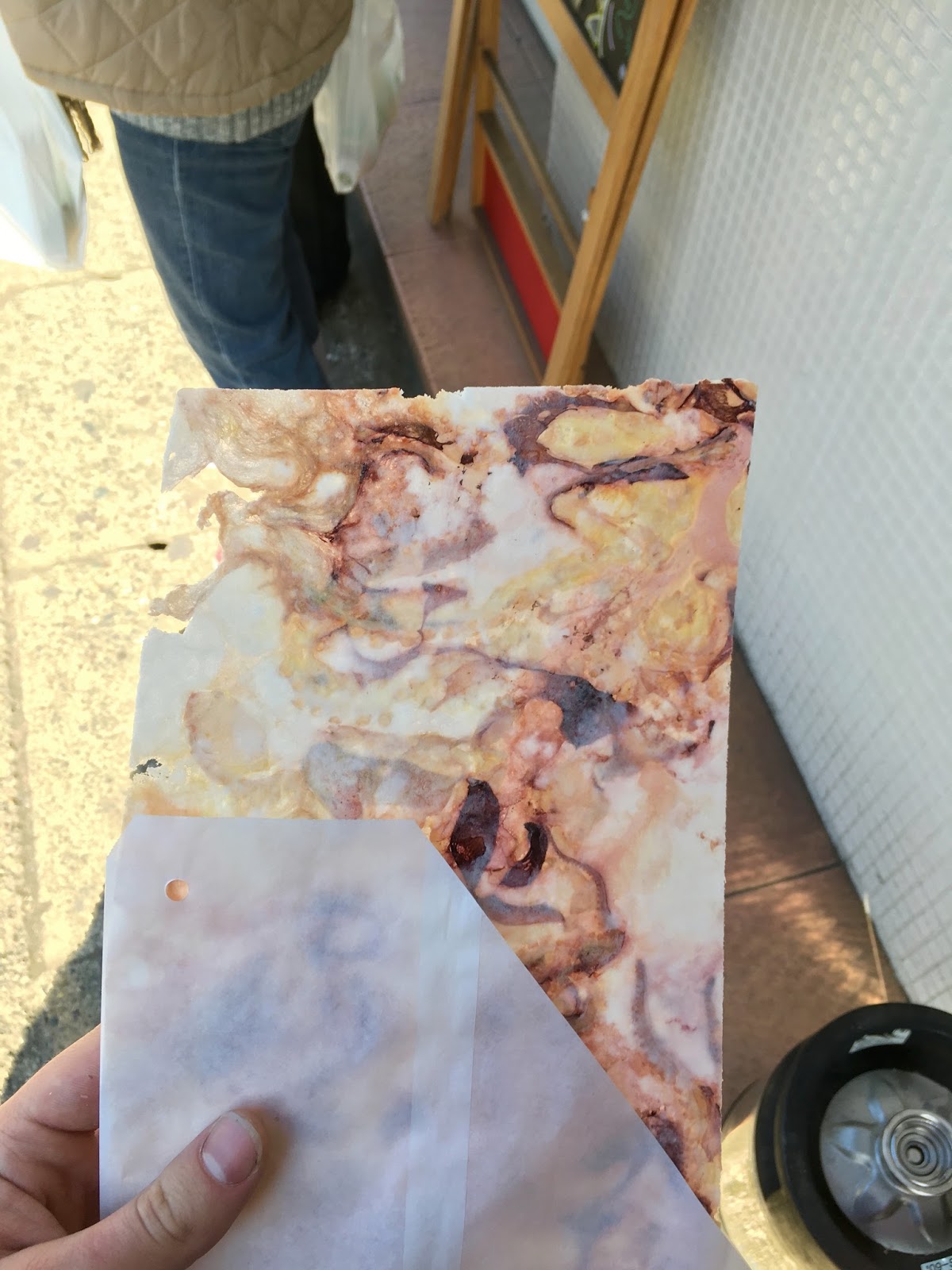
After a stroll though the town up towards the hills, I had a rather interesting snack. They are a thin crispy, brittle crackers, prepared by pressing flour and octopus very tightly between two hot plates.

What comes out are some amazing patterns, the food is better to look at than it is to eat.
I then headed up to Kamakura's most famous site, the Great Buddha (Daibutsu), who was looking very photogenic on such a clear day.

This giant, 13m tall Buddha was cast completely out of metal in the 1250's and has withstood countless earthquakes, with only mild weathering to show, it's actually quite the engineering masterpiece.


Inside you can take a look at the other side of the metal, the thing must be at least 6in thick from the looks of things, and isn't held up by an interior structure like the statue of liberty. You can see the mild touch up it has had around the neck and head.

The leaves are some wonderful colors at this time of year, a real mix of greens, reds and yellows.

After the Buddah, I started on a mild hike through the hills surrounding Kamakura. Before I left, I noticed a tiny little shrine down some tiny empty road, in sharp contrast to the grand, tourist-laden shrines I had been visiting prior.

And so the Kuzuharaoka-Daibutsu Hiking Course begun.

Quite a steep initial climb, and the forresty trail offered only short glimpses out over the rest of Kamakura.


It was a nice serene break from the bustling cities I have usually been exploring, and the locals were always friendly, greeting me with a 'Konnichiwa!' as I walked.

The end point of the trail was a Kuzuharaoka Jinja Shrine, a Shinto shrine, and I was back in busling tourist town.


I then took a break from visiting shrines to visit a Zen Buddhist Temple. In a sharp contrast to the bright colors and ornamentation of Shinto shrines, the Zen temples are very serene locations, architecturally offering a monochrome, geometric interpretation of the same traditional Japanese building.


Its clear to see how these spaces, with a juxtaposition of the un-ornamented, colourless, geometric built environment with a heap of natural beauty, were such an inspiration for the early modernists.
There was however this charismatic guy, who with a belly rub and a donation will give you his best wishes.

Even more clear an inspiration was the traditional Japanese home. of which there were several examples at the temples.


Truth to materials, flexibility, modular spaces, unobtrusive design?? This was basically stolen in the 1890's.

The tatami mats are all one standard size and separate the occupants from wood flooring. The paper doors can slide in and out, turning two rooms into one, or opening up to let in vast quantities of natural light. Even when closed they provide privacy, while allowing light to diffuse through.


Are you sure we aren't in Glasgow, 1918?? Charles Rennie Mackintosh has some explaining to do.

And so ends this Saturday's tour of Kamakura. It was wonderful to see some of the traditional aspects of Japanese life, and it's extraordinary how much of a direct influence this was on the early modernists. These quiet, natural spaces I think must have forgotten in the post-war period, as attention passed onto pure geometry, glass, steel and concrete.
Nice to see you got into some countryside!
ReplyDeleteAh, that sounds like such a lovely way to revisit Kamakura! I love how going back lets you notice the little corners and hidden spots you might have missed the first time—it always feels like the city has a whole new personality on a second visit. Focusing on the fringes must have given you such a fresh perspective, away from the usual hustle of the centre. Your experience kind of reminds me of hunting for unique finds online, like I was recently browsing for some pieces from liu jo dubai and felt that same thrill of discovering something special you might have overlooked before.
ReplyDeleteKamakura really does have a way of pulling you back, doesn’t it? It’s one of those places where even if you’ve visited before, it still feels like there’s more quietly waiting to be discovered. Focusing on the fringes sounds like a great idea too, because sometimes the smaller temples, quiet streets, and less crowded spots end up leaving the strongest impression. I had a similar feeling after my second visit, like I finally slowed down enough to appreciate the atmosphere. Honestly, trips like that make me realize how refreshing it is to step away from everyday stress for a bit, especially when things like exams are hanging over your head and you start joking with friends saying someone should just Hire someone to take my online philosophy exam so you can enjoy the moment a little longer.
ReplyDeleteFinding high-quality bedroom solutions starts with exploring trusted bed shops belfast that offer a wide range of styles and designs. From modern frames to classic wooden finishes, these shops cater to different tastes and budgets. Customers can expect expert guidance, helping them choose the right bed for comfort, durability, and overall bedroom aesthetics.
ReplyDelete